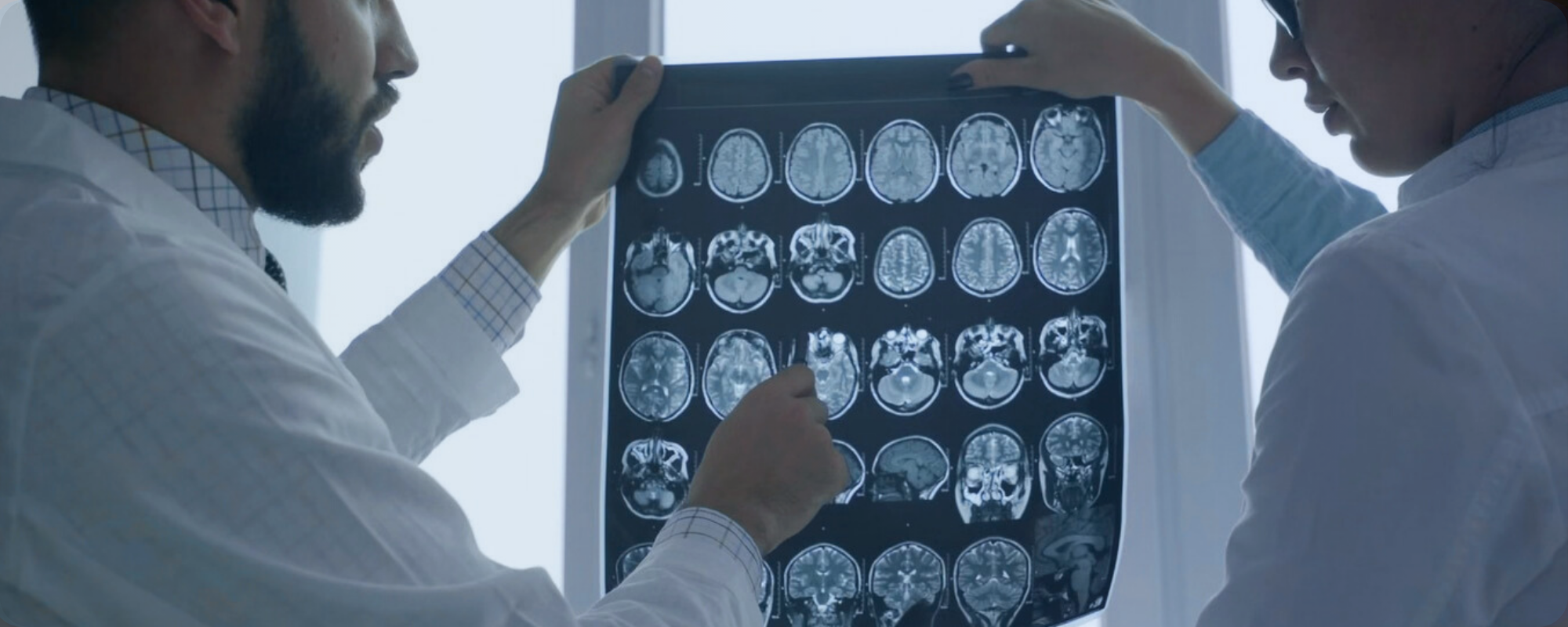
Modern radiology has become one of the most data-heavy fields in medicine. Every year, more than 500 million CT and MRI scans are produced worldwide, yet access to diagnostic expertise remains uneven and fragmented across regions. Machine learning could help build infrastructure that actually shortens reporting times and makes specialist expertise available where it’s missing.
Acting proactively
Staff shortages and increasing diagnostic queues are global trends:
- The number of imaging studies is growing faster than the radiologist workforce.
- Majority of EU countries have less than 150 radiologists per 1,000,000 inhabitants and uneven geographical distribution amplifies the problem, especially in large countries.
- Even countries with highly-developed healthcare systems consistently struggle to meet defined waiting time targets.
- In Poland, differences in wait times across provinces can exceed 80 days, even though all residents pay the same healthcare taxes. Routine and non-urgent MRI queues may reach 80 days or more.
 Source: Springer, Current status of radiologist staffing, 2025, (EU average in red)
The demand for imaging continues to grow due to several factors:
- aging population,
- increased health awareness and preventive diagnostics,
- growing use of imaging per patient,
- expansion of private healthcare providers.
This creates an imbalance between the volume of data produced and the available diagnostic capacity. If we react early, we still have time to build systems that scale before the backlog becomes unmanageable and demand outpaces our ability to respond. Medical data, when used responsibly and with appropriate consent and supported by public education and awareness, can help healthcare systems in managing future demand.
PACS & DICOM
Radiology is one of the most technologically advanced and digitized branches of modern medicine, and its data is already standardized. Imaging networks in hospitals rely on PACS (Picture Archiving and Communication Systems) for the storage, management, and distribution of medical images. These systems operate based on DICOM (Digital Imaging and Communications in Medicine), an international standard for storing and processing medical imaging information. This enables interoperability across devices from different manufacturers and generations, ensuring backward compatibility and usability even for older images.
Data complexity beyond images
While imaging data is standardized and widely available through systems like PACS, it represents only one part of the diagnostic process. Reliable machine learning systems require more than images alone.
A complete training dataset would need to include:
- medical images (e.g., CT, MRI, X-ray),
- corresponding radiology reports,
- relevant clinical context, such as patient history and prior conditions.
This is where complexity increases, as this type of data is not as strictly standardized as imaging data. It may exist in various forms, ranging from structured records to unstructured notes, PDFs, or even physical documents. This is also where new standards will likely have to emerge to address the fragmentation of data. Solving that problem would enable the implementation of the proposed project and also enhance existing PACS systems, creating a fully integrated ecosystem.
Concept overview
In simplified practice, the system could look like this:
- Patient does a scan.
- Patient gives consent for data sharing.
- Data is sent to the system and anonymized upon entry.
- In the background, a centralized system processes the data and trains the models.
- ML-based systems perform preliminary analysis and generate automated report.
- The radiologist always performs the final review and updates the system, enabling a continuous feedback loop.
Because PACS infrastructure is already widely adopted, new solutions can integrate with existing systems rather than replicate them, following the same standards. This makes radiology particularly well-suited for large-scale machine learning, where new tools can act as an additional layer of analysis on top of established workflows.
Expanding such a system could enable early-warning mechanisms for radiology, similar to EWS/NEWS (Early Warning Score/National Early Warning Score). For instance, if we have 1,000 patients and 900 consecutive scans are stable and routine while the last one requires urgent attention, the system could help prioritize cases effectively. It would help allocating already limited workforce exactly there where it is needed.
Focus on tools
This initiative would focus on providing the tools and analytical infrastructure, not any form of patient data. Automated systems would process and analyze patient images without ever sharing the underlying imaging datasets with users. The anonymized datasets would be used exclusively to train machine learning models. This keeps the hospital-side footprint minimal. At the same time it makes the system easier to secure and deploy at scale.
Public infrastructure, not a commercial product
Software solutions for medical imaging already exist and perform very well within the scope for which they were designed. The problem is that they operate within relatively narrow domains and are always behind paywalls. They are commercial products rather than components of a global-scale standard.
Such infrastructure would be available to all authorized and verified entities like hospitals or other public medical centers. Instead of being controlled by private organizations through subscription or licensing models, all taxpayers from different countries would be free to benefit from it. A good comparison can be GPS. It was initially developed as a military project in the United States and only later became a globally accessible public infrastructure. A similar model could be imagined for medical imaging infrastructure: a publicly governed system that provides universal access to advanced diagnostic tools.
Availability challenges
One of the first issues is making it globally available with no exclusions while following existing medical regulations like HIPAA, GDPR or international standards like ISO 13485 & ISO 14971. The system would need to be highly centralized with hospital-side software footprint minimized. That would reduce deployment complexity and operational costs.
Education and technological awareness
Public education is essential. Many people are understandably concerned about how their data might be used. Addressing these concerns transparently and clearly communicating the societal benefits would be critical for gaining public trust. A system designed for the public can only succeed if people are actively informed and engaged from the outset.
Operational complexity and scale
Data would have to be anonymized as soon as it enters the system. No identifiable information should be stored at any stage of the processing lifecycle. Personally identifiable information (PII) is a valuable target for attackers because of the many different ways it can be exploited. Even when anonymized, large medical imaging datasets remain a high-value asset. They could be reused not only for research and machine learning, but also for unauthorized commercial purposes or other improper uses.
The system should be tested locally first, before scaling internationally. Local deployments would allow testing and validation of operational procedures, ensuring potential issues are identified and resolved before scaling to a global network. International legal frameworks should define data handling, privacy, and security compliance to ensure uniform standards. This approach would enable controlled and reliable expansion of the system.
References
- Springer (2025), Current status of radiologist staffing, education and training in the 27 EU Member States: https://link.springer.com/article/10.1186/s13244-025-01925-7
- Boyes Turner (2025), Royal College of Radiologists’ Workforce Census warns UK has insufficient radiologists to provide safe patient care: https://www.boyesturnerclaims.com/news/workforce-census-warns-UK-has-insufficient-radiologists
- NIH (2023) The Growing Problem of Radiologist Shortages: Korean Perspective: https://pmc.ncbi.nlm.nih.gov/articles/PMC10700998/
- OECD (2020), Waiting Times for Health Services: Next in Line: https://www.oecd.org/content/dam/oecd/en/publications/reports/2020/05/waiting-times-for-health-services_9d746179/242e3c8c-en.pdf
- Queues monitoring project in Poland: https://onkoskaner.pl/